Featured

Developing the Research Impact Canada (RIC) Logic Model and Evaluation Framework: A Case Study Example

by Anne Bergen 

In 2017-2018, I helped the RIC Evaluation Committee develop a logic model and evaluation framework. This brief case study, originally posted at Research Impact Canada, describes that project.

Summary

This brief case study example describes a project working with Research Impact Canada (RIC) to create an evaluation framework, beginning with co-creation of a logic model.

Research Impact Canada (RIC) is a network of 16 universities dedicated to using knowledge mobilization to create research impact for the public good. In this project, a small group (the RIC evaluation committee) collaborated through four online workshops to define an evaluation framework that represented the shared knowledge mobilization activities of the larger collaboration, and aligned the framework with goals from RIC’s strategic plan.

This work expanded RIC’s past evaluation approach that focused on monitoring through counting outputs (the products of RIC activities). The current framework explains how activities link to short-term outcomes of improved knowledge, skills, and attitudes, which contribute to longer-term changes of improved individual practice, organizational capacity, and systems support.

Key messages of this case study

  • Work together in a small group to create a collaborative and iterative logic model and evaluation framework, where the group represents the diverse perspectives of a partnership initiative.
  • Create a logic model that maps out target audiences, common activities, what success looks like (outputs, outcomes, impacts), and enabling conditions.
  • Then use that logic model to guide decisions around what and when to measure. Instead of trying to measure everything, focus what’s important and what’s feasible.

Read the full case study: http://researchimpact.ca/developing-the-research-impact-canada-ric-logic-model-and-evaluation-framework/
Rhetoric to Reality: Presenting at C2U Expo 2015

by Anne Bergen & Andrea LaMarre

https://twitter.com/andrealala89/status/603547278041817088

This year, C2UExpo was in Ottawa, at Carleton University. As frequent collaborators, we were able to relax and enjoy telling and listening to stories about community university partnerships. Fellow presenters @sharonaverona and Elizabeth Jackson were really great, as were the audience who attended. It was an amazing morning that helped us think about our work in new ways.

Both in preparation for and after the presentation, we reflected on how being a rhetorician seems to be part of the process of proposing sessions for conferences. We are asked to “sell” our work in a way that makes it stand out against the (supposed) floods of submissions. With conference abstract deadlines months in advance of the talk, we often have to speculate about where our work might be by the time we present. This speculation can lead to a feeling of never being able to live up to our promises; indeed, with a session cheekily named “Lost in Translation? Rhetoric and Practice…,” we wondered how we would actually deliver a talk that speaks back to the processes we participate in, even just by attending and presenting at the conference.

We  decided that we would try to tell some stories that provoked problem-solving and reflection in our audience. We created and shared vignettes about how expectations can create reality and how knowledge is shared among people and in organizations. With the help of the audience, we considered how we could “change the story” and better collaborate to create, share, and use research.

One full story, a selection of conference presentation tweets, and an overview of our other two stories follows.

Continue reading “Rhetoric to Reality: Presenting at C2U Expo 2015”

Worst Case Scenario: An Exercise

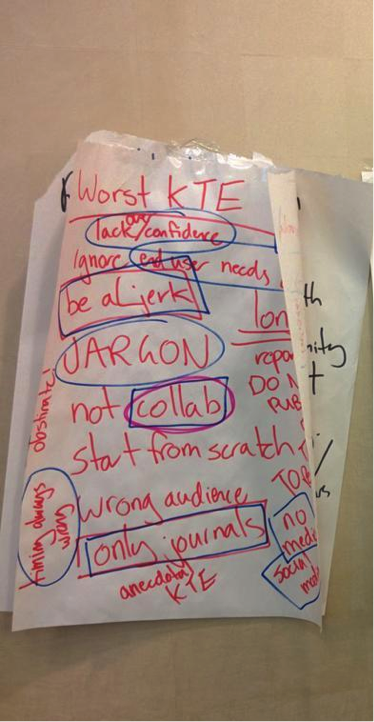
To get better, sometimes you have to think about the worst case scenario. This blog post is about a facilitated workshop activity that considers worst practices to support personal and collaborative change. Worst KTE practices

by Anne Bergen

What is the worst way that we can mobilize knowledge?

Knowledge mobilization* is about making information useful. It’s about:

  • helping information and knowledge flow among individuals and groups,
  • making decisions based on the best available evidence, and
  • creating relationships among people and networks.

The loftiest goals of knowledge mobilization are transformational, not just transactional. We want people not just to accept parcels of knowledge, but also to change their thoughts, feelings, and actions based on that knowledge. We want people to think and behave differently than they did before.

But there’s a problem. During knowledge mobilization training, it’s possible to get stuck on multi-layered definitions and conceptual models, leaving participants unable to answer the question:

“What does good knowledge mobilization look like?”

Yes, knowledge mobilization is about transformation of research knowledge into policy and practice. But non-specified “policy and practice” are dull. It’s hard to muster sustained enthusiasm for “policy and practice”, and it’s hard for trainees to be able to think about those terms in ways that are relatable and relevant.

Instead, a great way to start off a knowledge mobilization workshop is to think about worst practices, not best practices. That is, what could the participants do to get a really, really terrible result? What does knowledge immobilization look like?

Continue reading “Worst Case Scenario: An Exercise”

List of resources and process suggestions to help NGOs deal with data requests from researchers

e.g., how does research work, what should NGOs expect from researchers, how can NGOs best protect their clients, how to address issues of access to data, etc….

by Anne Bergen

Background

These resources were sent in response to a request I sent to the KTECOP.ca listserv, the CBPR mail list, and the CFICE project. I was asking for recommendations about “resources aimed at community partners/NGOs who are struggling to deal with data requests from researchers.” (original text appended at the end of this document).

There was a strong response to this request – over 20 respondents provided diverse resource and process suggestions, and stories of dealing with similar issues. Although there are resources available, there are also gaps and a need to adapt resources to different contexts and sectors. There was also interest in exploring collaboration from a few people working in this area.

This blog post is a complication of these resource and process suggestions. Feedback is still trickling in, and I will update the list as suggestions arrive. Please share these resources widely! Many thanks to all who contributed.

Continue reading “List of resources and process suggestions to help NGOs deal with data requests from researchers”

Health Jam 2014: Lessons Learned for Knowledge Mobilization

A musical “jam” is improvised collaboration among musicians. Musical improvisation – creating something new without extensive preparation or practice – has been proposed as a model for innovation and social change (see for example the multi-disciplinary Improvisation, Community, and Social Practice project funded through the SSHRC Partnership program).

Happily, those of us who lack the skill for musical improvisation can still jam. The “rules’ of non-musical jamming come from design thinking methods and create a framework for rapidly developing prototypes of ideas designed to address a particular problem or issue. Design thinking is a “human-centred” approach to innovation – a form of structured brainstorming, testing, and iteration that repeatedly tests prototypes against the needs and attributes of end-users.

The global series of GovJam events are two day workshops aimed at building collaborative and innovative solutions to public sector problems. In turn, GovJam events were inspired by ongoing Global Service and Global Sustainability jams, with the tagline: “48 hours to save the world”. Jamming appears to be a rhizomatic practice, like the stem of a plant that grows through laterally spreading roots and shoots, with past Jam participants spreading outwards to create new Jam events in different places and with different areas of focus.

Continue reading “Health Jam 2014: Lessons Learned for Knowledge Mobilization”